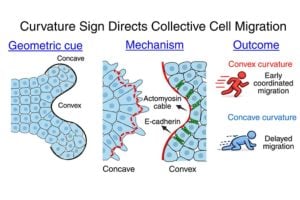
For most people, the dreaded papercut heals much faster than an entire scraped knee. The biology behind wound healing has mostly agreed with this observation, suggesting a wound’s size is typically the biggest factor in how quickly and thoroughly it will heal. But new research from Johns Hopkins engineers suggests another factor may also play an important role: geometry. In a study published in ACS Nano, the researchers found that tiny geometric differences—specifically whether a surface curves inward or outward—can systematically influence how groups of cells collectively move and organize. The findings could inform future approaches in tissue engineering, regenerative medicine, and bioinstructive material design.
The team, led by Ishan Barman, professor in mechanical engineering, looked into how geometry influences collective cell migration—a fundamental process involved in wound repair, tissue formation, and many other biological functions. Focusing on epithelial sheets—tightly packed layers of cells that help protect and repair tissue—they examined how cells respond to convex (outward-curving) and concave (inward-curving) environments. They found that cells consistently advanced into and populated convex regions earlier, while concave regions showed delayed and less coordinated migration.
“The key idea is that the cells encounter alternating geometric environments as they move, almost like navigating hills and valleys at the microscale, allowing us to isolate how curvature itself influences collective migration,” Barman says.
Ishan Barman
Epithelial cells play a central role in maintaining and repairing tissues throughout the body. During processes such as wound healing, these cells move collectively as coordinated sheets, closing gaps and rebuilding protective barriers. When this coordination breaks down, healing can slow and tissues become more vulnerable to infection and damage.
But wounds are often jagged, deeper in some parts than others, or involve swelling or atrophy, all of which can alter a wound’s shape. To study how geometry alone influences collective migration, the team engineered microscopic landscapes containing alternating inward and outward curves. Using patterned gold-and-glass surfaces, they created environments that allowed epithelial cell sheets to migrate across carefully controlled geometric boundaries.
At first, the cells adhered to the glass regions before the researchers triggered migration by selectively activating fibronectin, a key protein involved in wound healing and tissue repair, within the neighboring gold regions. This effectively created a biochemical “go” signal that induced the cells to migrate across the patterned landscape. The team found that the cells consistently advanced into convex regions earlier and more robustly, while migration along concave regions was delayed and less coordinated.
The migrating epithelial cells move collectively as sheets and behave almost like a rope, tightening across convex edges and loosening across concave edges. The tighter the “rope,” the greater the cell-to-cell adhesion. The researchers measured this cellular “stickiness” by tracking E-cadherin, a protein that acts as a kind of molecular glue between neighboring cells.
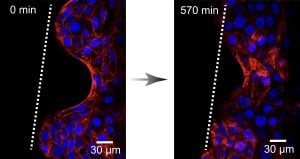
Still frame of the cells migrating along the curved substrates
The findings suggest that the sign of the curvature—whether a surface curves inward or outward—plays a more important role in organizing collective migration than the precise magnitude of the curvature itself.
“One of the reasons we find this exciting is that it points toward a different way of thinking about how cells can be guided and organized,” says Swati Tanwar, assistant research scientist in mechanical engineering and lead author of the study. “Traditionally, most efforts to control cell behavior have relied on biochemical signals, such as growth factors, drugs or engineered molecular coatings. Our work suggests that geometry itself may serve as an instructive signal.”
This insight could help scientists design better biomaterials or regenerative surfaces that guide how tissues organize and repair themselves. The findings may also be relevant for tissue engineering more broadly.
“A major challenge in building artificial tissues or organ-like systems is getting cells to organize properly over large areas,” Barman says. “Our results suggest that geometry could become a design parameter for controlling how tissues assemble, migrate, and maintain structural integrity.”
Johns Hopkins co-authors of the work are Yun Chen, associate professor in mechanical engineering, and Lintong Wu, who recently completed his PhD in mechanical engineering.