
NASA’s 2022 DART mission demonstrated that we can intercept an asteroid with a human-made object and alter its trajectory—and even possibly destroy it—potentially preventing a collision with Earth. But what happens to the debris created by the impact? A team of Johns Hopkins engineers has developed a method to track what happens to debris generated during impacts in three dimensions—the first time this has been achieved.
The team, led by Ryan Hurley, an associate professor of mechanical engineering, and co-deputy director of the Hopkins Extreme Materials Institute (HEMI), used 3D technology including laser sheets and high-speed cameras to collect data far more detailed than previous two-dimensional approaches. Using concrete as their target, the engineers fired projectiles inside a chamber using a gas gun at speeds up to about 1.25 miles per second, monitoring each particle as it flew off the sample.
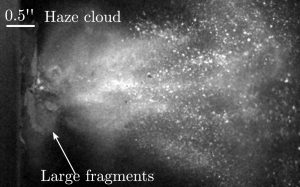
One stage of the impact experiment on concrete captured using high-speed video imaging at 0.5 million frames per second.
“We saw that higher speed impacts caused debris to move faster—which is logical,” says Sohanjit Ghosh, a PhD student in mechanical engineering and lead author of the study. “But what we further found was that it’s the kinetic energy at impact, not the pressure that’s present, that dictates how much ejecta there is and how far it goes.”
Their paper, “Quantifying 3D ejecta velocities during high-velocity impact experiments into concrete,” was published in the International Journal of Impact Engineering.
“The implication is that peak pressure is not a reliable metric on its own for predicting ejecta velocity,” Hurley says. “Experiments using similar kinetic energy but varying impactor materials, sizes, and velocities showed similar ejecta velocities. This implies that kinetic energy is directly correlated with the ejecta velocities.”

Ryan Hurley
The team plans to expand their experiments beyond concrete to sandstone, granite, and basalt. They are also developing numerical models that can replicate the experiments and predict the ejecta behavior. This could have implications for space engineering—and beyond.
“Understanding ejecta velocities could help protect our assets during missile strikes and drive the development of new armor and infrastructure materials to safeguard people and property” Ghosh says. “Additionally, in the context of planetary defense, regulating the amount of ejecta produced during asteroid impact could allow us to control its deflection.”
Other major contributors to this work and co-authors on the paper include: Mark Foster, associate professor of electrical and computer engineering; Zhifei Deng, HEMI postdoctoral fellow; Colin Goodman and Roberto Nunez, PhD students in electrical and computer engineering; Gangmin Kim, mechanical engineering undergraduate; and Justin Moreno, HEMI staff engineer.